The Apple iPhone 13 series constituted a significant overall update to its predecessor, the iPhone 12. Incremental upgrades all around place the iPhone 13 as an outstanding handset that’s sure to satisfy Apple fans. Even with the introduction of the iPhone 14 in 2022, the iPhone 13 remains an excellent handset—which is now even cheaper thanks to being an older model.
Both the iPhone 13 and its Pro variant are excellent handsets. While the Pro and non-Pro tiers share a lot in common, we think the iPhone 13 Pro is the best overall device, especially for photo enthusiasts and power users. More casual phone users will get by just fine with the more basic iPhone 13.
iPhone 13 vs. iPhone 13 Pro: Specs
For its iPhone 13 series, Apple’s iPhone maintains a familiar roster. While you can select from four different models, there are two main categories: Pro and non-Pro. Both the vanilla iPhone 13 and the 13 mini share most of the same underpinnings. Likewise, the Pro and Pro Max have nearly identical internals.
iPhone 13 models compared
| Specs | iPhone 13 mini | iPhone 13 | iPhone 13 Pro | iPhone 13 Pro Max |
|---|---|---|---|---|
| Debut starting price | $699 | $799 | $999 | $1,099 |
| Display | 5.4 inches Super Retina XDR |
6.1 inches Super Retina XDR |
6.1-inches 120Hz Super Retina XDR |
6.7 inches 120Hz Super Retina XDR |
| Camera | Rear: 12MP dual-lens Front: 12MP |
Rear: 12MP dual-lens Front: 12MP |
Rear: 12MP triple-lens Front: 12MP LiDAR scanner |
Rear: 12MP triple-lens Front: 12MP LiDAR scanner |
| Processor | A15 Bionic Four-core GPU |
A15 Bionic Four-core GPU |
A15 Bionic Five-core GPU |
A15 Bionic Five-core GPU |
| Onboard storage | 128GB, 256GB, 512GB | 128GB, 256GB, 512GB | 128GB, 256GB, 512GB, 1TB | 128GB, 256GB, 512GB, 1TB |
| Battery capacity | 17 hours video playback | 19 hours video playback | 22 hours video playback | 28 hours video playback |
| Water resistance | IP68 | IP68 | IP68 | IP68 |
| 5G compatible | Yes | Yes | Yes | Yes |
| Available colors | Pink Blue Midnight Starlight PRODUCT(RED) |
Pink Blue Midnight Starlight PRODUCT(RED) |
Gold Silver Graphite Sierra blue |
Gold Silver Graphite Sierra blue |
| Pricing and availability | View Plans | View Plans | View Plans | View Plans |
The 13 and mini come with 128GB, 256GB, or 512GB of onboard storage. Both feature Super Retina XDR 60Hz OLED displays. Available colors include pink, blue, midnight, starlight, and PRODUCT(RED). A dual 12MP rear-facing camera array comes standard. Its primary shooter works great for snapping photos, taking videos, or even scanning documents.
Stepping up to the Pro models gives you a 120Hz adaptive refresh rate on their Super Retina XDR displays. The Pro and Pro Max add a 1TB storage option for twice the storage of the non-Pro models, and their triple camera configurations add a telephoto lens. Color options include gold, silver, graphite, and Sierra blue.
Screen sizes, battery life, and prices vary by model. Aside from display size, battery capacity, and cost, the iPhone 13/13 mini and Pro/Pro Max share the same basic foundation. That means not much difference between the phones in each pair, other than their sizes and weights.
iPhone 13 128GB

| Description | |
|---|---|
| Screen Size | 6.1" |
| Available On | 53 Plans from 7 carriers |
| Available From |


|
| Priced From | $8 per month + $359 upfront |
| View Full Details |
 Apple's 2021 model featuring new Ultra Wide and Wide cameras, new sensor-shift image stabilization, Cinematic mode, more 5G bands, 6.1" Super Retina XDR display and more battery

iPhone 13 Pro 128GB
| Description | |
|---|---|
| Screen Size | 6.1" |
| Available On | 0 Plans from 0 carriers |
| Available From |
|
| View Full Details |
 Apple's 2021 model featuring new Ultra Wide, Wide and Telephoto cameras, new sensor-shift image stabilization, Cinematic mode, more 5G bands, 6.1" Super Retina XDR display with ProMotion and more battery

Universal to each model in the iPhone 13 lineup is an A15 Bionic chip, IP68 water resistance, and improved 5G capability over the iPhone 12. However, the A15 Bionic processor in the Pro/Pro Max adds an extra GPU core for better performance.
Pricing and Storage Options

Prices begin at $699 for the 128GB iPhone 13 mini, $799 for the standard iPhone 13, $999 for the Pro, and $1,099 for the Pro Max. Higher storage capacities will cost you more. Want the 1TB iPhone 13 Pro Max? Be prepared to shell out $1,599. As is expected, more storage is more money. Your options are as follows:
- iPhone 13/mini: 128GB, 256GB, 512GB
- iPhone 13 Pro/Pro Max: 128GB, 256GB, 512GB, 1TB
The iPhone 13 lineup has a lower starting price; however, the Pro and Pro Max add a higher storage tier. Still, most people likely won't need a whopping 1TB of storage, making the iPhone 13 the best deal of the bunch.
There are plenty of iPhone 13 deals and plans. Whether you want to upgrade from an old iPhone, switch carriers, purchase an unlocked iPhone, or something else, there’s undoubtedly an option to fit your needs. Check out the best iPhone 13 deals on the market, and browse the most popular iPhone 13 plans below.
iPhone 13 128GB Plans

|
#1
|
Tello

Unlimited Text, Talk, and 20GB Plan
$20.00/mo
+ $359 Upfront
|
|
#2
|
Simple Mobile

15GB Data Plan
$23.75/mo
with AutoPay
+ $253.99 Upfront
|
|
#3
|
Straight Talk

Platinum Unlimited Data Plan
$60.00/mo
+ $199 Upfront
|
|
#4
|
Total Wireless (previously Total by Verizon)

Total STARTER Plan
$35.00/mo
with AutoPay ($40 for the first month)
+ $199 Upfront
|
|
#5
|
Verizon

Unlimited Ultimate
$85.00/mo
+ Taxes & Fees. Price includes AutoPay & Paperless discount.
+ $669.99 Upfront
|
Winner: iPhone 13
iPhone 13 vs. iPhone 13 Pro: Design and Build
Each phone in the iPhone 13 lineup features IP68 water resistance. Although the iPhone 13 isn’t waterproof, it should handle submersion in up to 4 meters of water for a maximum of 30 minutes. The standard iPhone 13 models have aerospace-grade aluminum cladding, while the Pro models get an upgrade to surgical-grade stainless steel. Both will be sturdy and well-constructed.
You can select the iPhone 13 in Midnight, Starlight, Blue, Pink, and PRODUCT (RED). The 13 Pro comes in Silver, Gold, Graphite, and Sierra Blue. All models include a 20% smaller notch for the Face ID housing.
There’s not much variation in build between the standard iPhone 13 and the Pro. In fact, from a design perspective, the iPhone 13 doesn’t deviate much from the iPhone 12 series. Sure, the notch is a bit smaller, and there are different color options, but the vanilla iPhone 13 and the Pro series aren’t too dissimilar.
Winner: Tie
iPhone 13 vs. iPhone Pro: Display

All variations of the iPhone 13 feature a Super XDR OLED screen. Size varies by model, though. The iPhone 13 mini features a 5.4-inch 2340 x 1080 pixel display, while the 13 and 13 Pro version is a 6.1-inch 2532 x 1170 pixel screen, and the Pro Max upgrades to a 6.7-inch 2778 x 1284 display.
-
iPhone 13 mini screen:
- 5.4 inches
- 60Hz refresh rate
- 2340 x 1080 pixels
-
iPhone 13/iPhone 13 Pro screen:
- 6.1 inches
- 60Hz (iPhone 13)l 120Hz (iPhone 13 Pro)
- 2532 x 1170
-
iPhone 13 Pro Max screen:
- 6.7 inches
- 120Hz
- 2778 x 1284
ProMotion display

Both iPhone 13 Pro models pack what Apple dubs its ProMotion display technology. ProMotion is a variable refresh rate (VRR) implementation capable of operating as low as 10Hz and as high as 120Hz. As an adaptive refresh rate, ProMotion automatically adjusts to your on-screen tapping and scrolling. For example, it dips down while slowly scrolling through an article but ramps up during fast-paced gaming.
- iPhone 13/mini: 60Hz fixed refresh rate display
- iPhone 13 Pro/Pro Max: Up to 120Hz variable refresh rate panel
Whether you’re immersed in your favorite iOS games such as Genshin Impact, reading articles on your favorite website (*cough* WhistleOut *cough*), or posting pics to Instagram, the ProMotion display ensures a smooth scrolling experience. In contrast, the iPhone 13 and 13 mini include 60Hz fixed refresh rate screens. Chances are, you won’t notice the difference for most basic tasks. However, there’s no denying that the faster, adaptive refresh rate screen found on the Pro and Pro Max is a better choice.
Winner: iPhone 13 Pro
Cameras and Video

Like the iPhone 12 series, the iPhone 13 comes with a different number of cameras depending on the specific model. Both the iPhone 13 and mini have a two-camera array consisting of a wide-angle 12MP shooter and an ultra-wide lens. Stepping up to the Pro/Pro Max adds a third telephoto lens. Aside from the number of cameras, the iPhone 13 Pro and Pro Max can shoot in the professional photography ProRaw format.
-
iPhone 13 mini/iPhone 13: Dual-camera array
- Wide-angle lens: 12MP, 1.7 µm sensor, ƒ/1.6 aperture, 26mm focal length, 7-element lens, 100% focus pixels
- Ultra-wide: 12MP ƒ/2.4 aperture, 13mm focal length, 5-element lens, 120-degree field of view
- Front-facing: 12MP
-
iPhone 13 Pro/Pro Max: Triple-camera array
- Wide-angle: 12MP ƒ/1.5 aperture, 1.9 µm sensor
- Ultra-wide: 12MP ƒ/1.8 aperture, 120-degree field of view
- Telephoto: 12MP ƒ/2.8 aperture, 3x zoom
- Front-facing: 12MP
Additionally, there’s a 12MP front-facing camera notch for selfies and Face ID phone unlocking. It’s 20% smaller than the 12’s camera bump, but still there (sorry, notch-less phone fans).
Photographic Styles
Apple’s Photographic Styles let you customize your pictures. Effectively, Photographic Styles are like Instagram filters but pre-applied. For instance, you can select lighting and contrast settings that get applied automatically when you take a picture. This is the same for the Pro and non-Pro iPhone 13.
Video
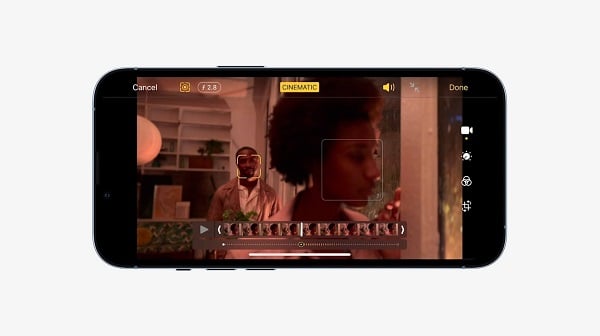
Both the Pro and non-Pro variants include a Cinematic Mode to capture 1080p video at 30 frames per second (FPS). You’ll also find the ability to shoot 4K, high dynamic range (HDR) video at up to 60 FPS with the Dolby Vision HDR standard. Basically, HDR gives your pictures and photos more color pop and better contrast.
Cinematic Mode also includes functionality for budding or even professional filmmakers. Its rack focus automatically adjusts focus while recording to lend a dynamic feel. Effectively, whether you’re recording a video for Instagram or shooting an indie film, your videos will come out with better focus. Despite the increased automation, you’ve got plenty of manual control with the ability to edit elements such as focus after recording.
Opting for the iPhone 13 Pro model gives you the ability to shoot in Apple’s cinema-grade ProRes 4K video recording in up to 30 FPS. Well, sort of. The 128GB Pro/Pro Max models can’t handle ProRes, because shooting super high-resolution video is going to eat through your storage space pretty quickly. Instead, you’re limited to 1080p at 30 FPS.
LiDAR scanner
Like the 12 series iPhone Pro, the 13 Pro models flaunt LiDAR, or Light Detection and Ranging. You’ll find this technology on autonomous vehicles and robot vacuums since it’s used for remote sensing.
The iPhone’s onboard LiDAR scanner provides a slew of benefits. For instance, your phone more accurately maps your surroundings when using augmented reality (AR) applications such as Pokemon GO!, which can help you avoid running into furniture.
Outside of AR, the iPhone 13 Pro’s LiDAR feature benefits photography. Essentially, it enables three-dimensional video and photo capture. Because of the iPhone Pro’s camera trio, alongside its LiDAR scanner, the Pro models provide better night mode portraits, improved low-light autofocus, and greater edge detection for better-defined objects in pictures.
Winner: iPhone 13 Pro
A15 Bionic Chip
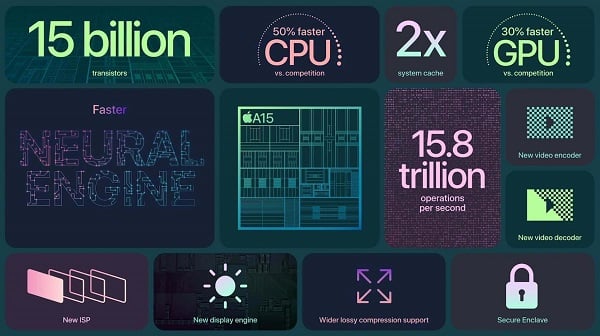
Under the hood, all iPhone 13 handsets get upgraded to the A15 Bionic processor. Impressively, it delivers increased processing power while introducing more efficiency. This means your battery will last longer while enjoying the same tasks.
- iPhone 13/mini: A15 Bionic chip with four-core GPU
- iPhone 13 Pro/Pro Max: A15 Bionic processor with five-core GPU
The A15 Bionic chip touts four high-efficiency cores and two high-performance cores alongside a faster neural processor. As such, on-device artificial intelligence (AI) and machine learning (ML) applications will run better. What does this mean for you? AI- and ML-powered tasks such as voice-to-text, Siri, and automatic photo editing are more accurate.
While the A15 Bionic powers the entire iPhone 13 lineup, the Pro and Pro Max get a graphics processing unit (GPU) bump. Truly living up to the Pro in its name, there’s a beefier GPU with five cores to the vanilla 13 and 13 mini’s four-core GPU. That should benefit graphics-intensive gaming or shooting/editing videos in the professional filmmaking video format ProRes.
In Geekbench tests, the iPhone 13 Pro clocked in a blisteringly fast 14216 score, a 55% increase over the 12 Pro’s 9123 Geekbench scores. The iPhone 13 is also no slouch with a 10608 score that tops the 12 Pro. While you can’t go wrong with the iPhone 13, if you want best-in-class performance, Pro is the way to go.Winner: iPhone 13 Pro
iPhone 13 Storage Capacity
Whereas previous iPhone models, including the 12 series, offered a base 64GB storage option, the 13 ups that to 128GB. The standard iPhone 13 and its mini sibling can be outfitted with 128GB, 256GB, or 512GB of storage space.
- iPhone 13/mini: 128GB, 256GB, 512GB
- iPhone 13 Pro/Pro Max: 128GB, 256GB, 512GB, 1TB
Opting for the iPhone 13 Pro variants gives you 128GB, 256GB, and 512GB tiers. Plus, the Pro adds a 1TB option for a high-capacity local storage option. Although cloud storage is convenient, having a ton of space to house your photos, videos, and music files is convenient.
Particularly if you’ve got an iPhone 13 Pro, the additional hard drive space lets you keep high-resolution pictures or videos worry-free. You won’t have to constantly upload pictures to the cloud and delete items to create more room on your device.
Winner: iPhone 13 Pro
Connectivity
All versions of the iPhone 13 sport 5G, Wi-Fi 6 (but sadly no Wi-Fi 6E), and Bluetooth 5.0. When compared with the iPhone 12, the 13 delivers 5G support for 200 more carriers across 60 new countries. But regardless of whether you pick the pocket-friendly iPhone 13 mini or the fully-loaded Pro Max, your connectivity won’t differ.
Although Apple graced its iPad mini with a USB-C port, the iPhone 13 retains a Lightning port. There’s not much difference in connectivity between various models in the iPhone 13 lineup.
Winner: iPhone 13 Pro
iPhone 13 vs. iPhone 13 Pro: Verdict
Ultimately, the iPhone 13 Pro is hands-down a better phone than its non-pro counterparts. You’ll get a better processor, more cameras, and advanced functionality, such as the ability to capture high-resolution photos and videos. However, some of those features require an iPhone 13 Pro/Pro Max with at least 256GB of storage. The 128GB iPhone 13 Pro and Pro Max lack ProRes support.
Just because the iPhone 13 Pro and Pro Max are superior to the iPhone 13 and mini that doesn’t mean the non-Pro iterations aren’t worth it. If you’re a power user, the iPhone 13 Pro will deliver best-in-class processing power, photo and video capabilities, plus more storage options. It’s a handset just as comfortable capturing your TikToks as it is recording footage for an indie film. Apple’s Pro models truly cater to professionals, whether that’s mobile gaming enthusiasts, amateur photographers, or simply tech buffs seeking cutting-edge technology.
- iPhone 13 Pro/Pro Max: Best overall, and best for power users
- iPhone 13/mini: Best for casual users
While these are undoubtedly worthwhile inclusions, the Pro may be overkill. If you mostly find yourself snapping Instagram pictures, streaming music, texting, and calling, the standard iPhone 13 will meet your needs. For a lower price, you get virtually the same phone minus some features you’d hardly use. Sure, the iPhone Pro is better in almost every way, but chances are you won’t notice in many cases. Even the cheapest iPhone 13 is an exceptional device that trounces most of the competition, including many Android devices and previous iPhone models.
Winner: iPhone 13 Pro
iPhone 13 vs. 13 Pro: FAQs
What is the difference between the iPhone 13 and iPhone 13 Pro?
The iPhone 13 and iPhone 13 Pro are extremely similar. However, the Pro includes a more powerful processor, an extra camera (telephoto lens), a larger screen size, a 1TB storage option, LiDAR scanner, and additional photo/video capabilities.
Both Pro tiers can shoot pics and videos in higher resolution formats than the non-Pro. You’ll find ProRes video recording in up to 4K 30 FPS on 256GB and higher storage models (limited to 1080p 30 FPS for the 128GB Pro/Pro Max). Similarly, the Pro iPhone 13s can capture Apple ProRaw pictures.
How much does the iPhone 13 cost?
iPhone 13 pricing varies based on the model and storage options.
-
iPhone 13 mini:
- $699 (128GB), $799 (256GB), $999 (512GB)
-
iPhone 13:
- $799 (128GB), $899 (256GB), $1,099 (512GB)
-
iPhone 13 Pro:
- $999 (128GB), $1,099 (256GB), $1,299 (512GB), $1,499 (1TB)
-
iPhone 13 Pro Max:
- $1,099 (128GB), $1,199 (256GB), $1,399 (512GB), $1,599 (1TB)
Does the iPhone 13 have a bigger battery?
The iPhone 13 has a bigger and better battery than the iPhone 12. Apple claims that the 13 mini flaunts a 1.5-hour battery life increase over the 12 mini, while the standard iPhone 13 sees a 2.5-hour boost over the standard iPhone 12. For the 13 Pro, you can squeeze 1.8 hours more juice than a 12 Pro, and the 13 Pro Max gets a whopping 2.5-hour upgrade over the 12 Pro Max.
When can I buy the new iPhone 13?
Apple’s iPhone 13 roster was fully unveiled on September 14, 2021, with pre-orders starting on September 17 and phones hitting shelves on September 24.
What upgrades does iPhone 13 have?
The iPhone 13 features upgrades in nearly every area when compared with the iPhone 12. It features a faster processor than the iPhone 12 series, a better camera, and improved 5G. The 13 Pro versions provide a bevy of benefits such as a fast adaptive refresh rate screen and outstanding photo/video capabilities. Progressive upgrades are collectively substantial enough to make you want to sell your old iPhone and use the money to purchase the 13.
Is there an iPhone 13 mini?
Like previous iPhone squads, there is a pocket- and palm-friendly mini version. The iPhone 13 mini comes with a 5.4-inch screen versus the 6.1-inch screen found on the 13 and 13 Pro.
Does the new iPhone 13 have a satellite link?
The iPhone 13 does have satellite link capabilities. With its Low Earth orbit (LEO) satellite connectivity, the 13 can call and text without a cellular signal. However, satellite link capabilities are limited to certain markets and situations. If you want to call and text anywhere around the world sans mobile internet coverage, you’re out of luck.
Can I trade in my old phone to get the iPhone 13?
If you’ve got an old (iPhone 12 or previous) iOS device, you can trade it in to get the new iPhone 13. There are tons of iPhone 13 deals available. You’ll find incentives on everything from the iPhone 13 mini to the Pro Max.
Does the iPhone 13 come with AirPods?
The iPhone 13 will not ship with AirPods. If you want a set of earphones, you’ll have to snag a pair of AirPods or an alternative such as Samsung’s Galaxy Buds Pro.
Does the iPhone 13 have a headphone jack?
The iPhone 13 lacks a headphone jack. Beginning with the iPhone 7, Apple nixed the physical 3.5mm jack in favor of a mostly portless design. Therefore, you’ll need to rely on Bluetooth wireless connectivity or a Lightning adapter for interfacing with wired audio components like speakers or headphones. Depending on your speakers/headphones, you’ll need a Lightning to 3.5mm headphone jack or a Lightning to USB-C adapter.
Moe Long
Senior Writer

Find a better phone plan
Thousands of cell phone plans unpacked. All the facts. No surprises.


.png?w=280&h=280&usm=20&usmrad=0.8&fit=crop "Best Cell Phone Deals for July 2026: Get the New iPhone 17 for Free")