Image: Daphne Kelly
T-Mobile 5G Home Internet is a wireless home internet service that uses the same T-Mobile 5G cellular network that powers your smartphone. With its widespread availability and bundling discounts, it's an excellent choice of internet service for customers who already have a T-Mobile phone plan.
We recently sent our WhistleOut expert Daphne Kelly to test T-Mobile's 5G Home Internet service and interview her next-door neighbor Zackary Richter (Zack), a real, long-time customer about his experience.
We found that:
- T-Mobile 5G Home Internet offers average download speeds around 100Mbps.
- Installation is easy, but requires some technical knowledge.
- The service is a solid value overall, with plans as cheap as $35/month when bundled with a T-Mobile postpaid wireless plan.
After our testing, Daphne was so impressed with the service, she's considering dropping her expensive cable plan and switching to T-Mobile 5G Home Internet for her personal internet service.
Overall, while 5G home internet is not the fastest or most reliable internet type, we feel it's an excellent choice for customers who want to bundle services with T-Mobile or can't hook up to a cheap cable or fiber connection.
Why you can trust WhistleOut
.svg)
15+
years of mobile industry experience

900+
published wireless guides

35+
firsthand carrier reviews
We've been around since the birth of the iPhone. Along the way, we've learned how to spot the best deals for your wallet (and your sanity). We spend our days researching informative guides and writing insightful reviews on every kind of wireless plan, distinguishing what matters from what doesn't. We played around with these plans before recommending them, ensuring they're worth your hard-earned money.
Want to know more? Check out how we review every cell phone plan we rank.
How we tested T-Mobile 5G Home Internet

Our WhistleOut experts tested the download speeds and connection strength for T-Mobile 5G Home Internet. We also interviewed a long-term customer to understand their experience with the service's daily performance, installation process, and customer service.
The features and scenarios tested included the following:
- Testing download speeds
- Downloading and uploading large files
- Following the installation process
- Speaking with T-Mobile's customer service
- Using the T-Mobile 5G Home Internet app
- Video chatting, streaming movies, and playing online games
- Online learning and remote work experiences
The bottom line
Starting as cheap as $35/month with a phone bundle, T-Mobile 5G Home Internet is an excellent value for wireless internet. Our testing showed it offers average speeds around 100Mbps, which is fast enough for average customers. It's also widely available thanks to T-Mobile's massive 5G wireless network.
On the other hand, wireless internet generally has slower speeds and lower bandwidth than wired internet connections like cable and fiber. This may be an issue if you frequently do internet-intensive tasks, like remote working, 4K streaming, or playing video games. It also requires self-installation guided by an app, which may be difficult for users less familiar with technology.
Finally, while the bundled price is competitive, its regular price is not, making it a less compelling choice for customers who don't already have a T-Mobile plan. Potential customers should consider switching to T-Mobile wireless if 5G home internet seems like the best option to meet their needs.
T-Mobile 5G Home Internet plans and pricing
T-Mobile 5G Home Internet has three plans:
- Rely Home Internet for $50/month
- Amplified Home Internet for $60/month
- All-In Home Internet for $70/month
The data speeds on these plans are largely the same, with Amplified and All-In being slightly faster than the Rely plan. Instead, the major differences between the plans are the type of free gateway router and other perks that T-Mobile adds to its more expensive plans. All plans are also contract-free and come with a 5-year price guarantee, so your rates won't suddenly increase.
T-Mobile 5G Home Internet plans
| Rely | Amplified | All-In | |
|---|---|---|---|
| Speed range* | 87–318Mbps | 170–498Mbps | 170–498Mbps |
| Data cap | Unlimited data | Unlimited data | Unlimited data |
| Equipment | T-Mobile Gateway | Wi-Fi 7 Gateway | Wi-Fi 7 Gateway, Mesh Wi-Fi extender |
| Price | $50/month | $60/month | $70/month |
| Perks | None | None | Hulu, Paramount+, Free 3-year equipment upgrade |
| Shop this plan | View at T-Mobile | View at T-Mobile | View at T-Mobile |
* Typical download speeds according to T-Mobile Fixed Wireless Broadband Consumer Disclosure.
T-Mobile Rely: Best for budget-conscious customers
If you want reliable home internet without paying a premium, the Rely plan is T-Mobile's most affordable option at $50/month or $35/month if you already have a T-Mobile wireless line. It covers the basics well and is a solid pick for individuals, couples, or light internet users who don't need a lot of extras.
- Typical download speeds of 133–415Mbps
- High-performance 5G gateway included
T-Mobile Amplified: Best for busy households
The Amplified plan steps things up with faster speeds and a newer Wi-Fi 7 gateway, making it a better fit for families or anyone juggling multiple devices at once. At $60/month ($45 with a T-Mobile voice line), it's the best upgrade if the Rely plan's speeds and features aren't quite cutting it.
- Typical download speeds of 170–498Mbps
- Faster speeds with T-Mobile's latest premium Wi-Fi 7 gateway included
- Supports more simultaneous users and devices without slowdowns
T-Mobile All-In: Best for power users
The All-In plan packs in the most value of any T-Mobile internet plan with over $480/year in free extras beyond internet service. At $70/month (or $55 with a voice line), it makes the most sense for larger households or anyone who wants streaming perks and tech support bundled into one monthly bill.
- Typical download speeds of 170–498Mbps
- Free subscriptions to Hulu and Paramount+ Essential Plan
- T-Mobile's latest premium Wi-Fi 7 gateway with mesh Wi-Fi extender included to eliminate dead zones throughout your home
- Advanced Cyber Security to protect all your connected devices
- 24/7 live tech support assistance via TechEdge Suite
- Gateway upgrade after year 3 to keep your hardware current
T-Mobile 5G Home Internet bundles
All of T-Mobile's 5G Home Internet plans can be bundled with a T-Mobile postpaid voice line for a $15/month discount. These bundles can include:
- Essentials Saver plan starting at $50/month
- Essentials plan starting at $60/month
- Experience More plan for $85/month
- Experience Beyond for $100/month
To get the cheapest price for T-Mobile wireless and internet service, you'd pick a bundle with the Essentials Saver plan. You can see how that pricing breaks down with each internet plan below:
| Internet plan | Pricing breakdown | Bundled price |
|---|---|---|
| Rely | $35/month (internet) $50/month (wireless) |
$85/month |
| Amplified | $45/month (internet) $50/month (wireless) |
$95/month |
| All-In | $55/month (internet) $50/month (wireless) |
$105/month |
How we rated T-Mobile 5G Home Internet: WhistleOut's metrics
Fact-checking T-Mobile's claims
Here at WhistleOut, we review all internet service providers using the same metrics: price, availability, performance and speeds, installation, and customer service. Each metric is assessed over a 5-star point system to calculate the provider's overall score.
T-Mobile 5G Home Internet's ratings were:
- Price: 4 out of 5
- Availability: 4 out of 5
- Performance and speeds: 3 out of 5
- Installation: 3.5 out of 5
- Customer service: 4 out of 5
The hands-on testing of T-Mobile 5G Home Internet—alongside real-world insights from a long-term customer—allowed us to experience the service as a regular customer would, ensuring our findings and recommendations are grounded in actual usage and not just in what the carrier claims to provide.
Price
One of T-Mobile Home Internet's most attractive features is its price. With average data speeds above 100Mbps for all of its plans, it's a solid value with plans starting at $50/month. However, the best pricing is unlocked when the service is bundled with a T-Mobile wireless plan and gets a $15/month discount.
Zack—our long-time T-Mobile 5G internet customer—pays just $145/month for his wireless and internet service. That includes a four-line family plan of T-Mobile Essentials lines, his internet service, two auto-pay discounts, and all taxes and fees.
On the other hand, if you aren't going to bundle, you should check all your other options for service first. While $50–$70/month isn't a terrible price for internet service, you may find a faster cable or fiber plan for roughly the same amount, depending on your local market.
Score: 4 out of 5
Availability

Image: T-Mobile
One of the big advantages of the service is T-Mobile's 5G Home Internet coverage is widely available. Since T-Mobile has the nation's largest 5G network, most cities and suburbs have access to the service. It's easier to join than the 5G internet networks of Verizon and AT&T.
However, there are still plenty of rural places where T-Mobile 5G internet isn't available. You may also run into an issue where you live in an area with a strong T-Mobile 5G signal but the provider still won't let you sign up. Remember, T-Mobile 5G Home Internet runs on cellular networks, so all tower bandwidth must be shared with both phones and home internet. If you live in a neighborhood where multiple people have already joined the service, T-Mobile may not think your local network can handle another internet plan yet.
How does 5G internet work?
Confused about how you can get home internet from a cell phone network? Check out our 5G home internet guide for the full rundown of how this service works.
You can also see how it compares to other internet types like cable, fiber, satellite, and DSL.
Score: 4 out of 5
Performance and speeds

Image: Daphne Kelly
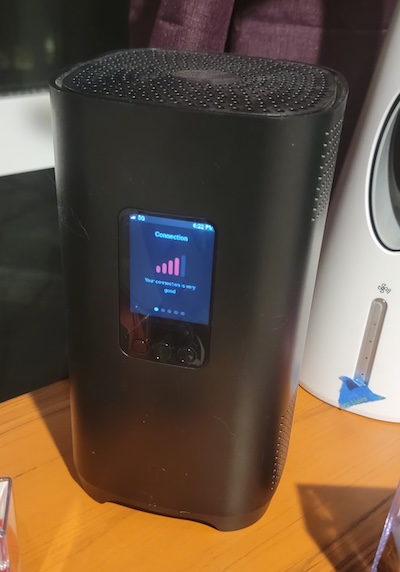
T-Mobile 5G Home Internet can be fast. Daphne measured average speeds around 131Mbps during her testing, which is solid for a wireless internet connection.
Since she lives right next door, Daphne actually forgot to disconnect from the Wi-Fi and rejoin her home's Sparklight cable internet when she was done testing Zack's connection. She told us the next day in our WhistleOut group chat, "I forgot to disconnect my phone from his Wi-Fi and used it all of last night. It was equally as fast as the Wi-Fi in my own home, so much so that I didn't notice until this morning. It was shockingly fast. Like, I tested my internet too, and his is faster than mine."
Daphne’s experience with T-Mobile 5G internet speeds

Daphne was extremely impressed when testing her neighbors T-Mobile 5G Home Internet and compared it to her cable plan:
"I forgot to disconnect my phone from his Wi-Fi and used it all of last night. It was equally as fast as the Wi-Fi in my own home, so much so that I didn't notice until this morning. It was shockingly fast. Like, I tested my internet too, and his is faster than mine."
T-Mobile maintains that its top internet speeds can get to almost 500Mbps. That said, everyone's experience is different, and most people shouldn't expect to have those fastest speeds.
5G internet is susceptible to slowdowns during peak usage times. In the evening between 7 p.m. and 11 p.m. when everyone is home using their internet, you can expect speeds to slow or be inconsistent. Zack also noted that when everyone in his household uses the service at the same time, he has sometimes noticed bouts of lagging when trying to do internet-intensive tasks like streaming.
Additionally, 5G home internet is location-dependent. Your top speeds and signal strength are directly related to how close you live to your local 5G tower and if there are any obstructions like buildings or trees in the way.
Finally, while the speeds and reliability of 5G internet are decent, they still aren't as good as top-tier cable or fiber plans. Those kinds of internet connections can offer speeds from 1–8Gbps and are much more consistent throughout the day.
Score: 3 out of 5
Installation
While simpler than satellite internet, T-Mobile 5G Home Internet is still a self-installation process. If you're not great with technology, you may struggle or make mistakes.
Each plan includes a free wireless gateway with a built-in SIM card for the T-Mobile 5G network.
You'll use the T-Life app to set up the system. It guides you to walk through your house measuring the signal strength in every room. The app will then tell you the best location for your gateway. Then all you have to do is plug it in. Zack reported the whole process takes around 30 minutes.
The problems in the process can arise when the app is looking for the strongest signal location, which is not necessarily near where your devices are. For example, T-Mobile will almost certainly tell you your upstairs bedroom is the best place for your gateway, but that's probably going to put off a very weak Wi-Fi signal for the TV and gaming console in the basement. Be prepared to try it in several different locations to find the best fit for all your Wi-Fi devices.
Zack ran into this problem when he originally set up his system and needed to contact customer service, who then guided him through finding a better spot. If you end up going with the All-In plan, the mesh Wi-Fi extender would also help your internet reach farther around your home.
Score: 3.5 out of 5
Customer service
Zack's experience with T-Mobile's customer service has been fine. The system works well, so he rarely has a need to speak with them.
Over the past three years, he's spoken with them twice. Once was when he needed troubleshooting help with installation, which they easily provided. The second time was when he considered switching to another carrier for his phone plan, so the carrier offered him an additional discount on his mobile service.
Score: 4 out of 5
Signing up with T-Mobile 5G Home Internet
Signing up with T-Mobile 5G Home Internet is easy. You'll need to enter your address to see if your home is eligible for the service. If you can sign up, you'll simply purchase your chosen plan on T-Mobile's website. The carrier will then mail you all the equipment for free.
T-Mobile also periodically offers 14-day or month-long free trials of its 5G home internet service. If you're unsure if you'll have a strong enough service at your home, we recommend trying one of these trial periods to see if the internet works well enough to keep.
Managing your plan with the T-Life app
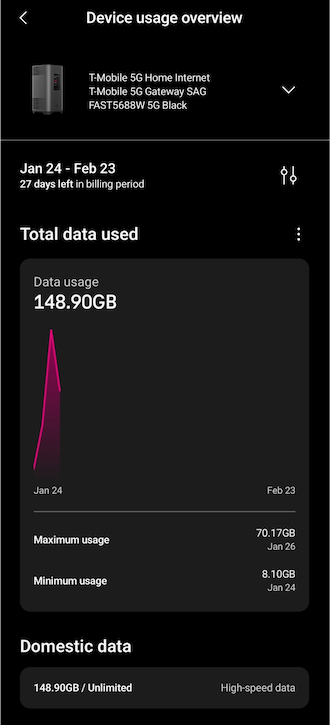
Image: Daphne Kelly
T-Mobile's 5G Home Internet is managed entirely with the T-Life app. You use it to set up the system, pay your bills, track your usage, and control who can access your Wi-Fi.
Zack reported that the app is easy to navigate and straightforward, but he rarely has to use it. He noted that T-Mobile did a good job making the internet into a "set it and forget it" system.
Did we like T-Mobile 5G Home Internet?
We were impressed with T-Mobile 5G Home Internet during our testing, and Zack has used the service for the past three years with virtually no problems.
With average speeds around 100Mbps and bundled pricing as low as $35/month, it's one of the more affordable forms of high-speed internet. It's a solid option for users who have average internet needs, like streaming, playing most video games, or even video chatting.
We liked it so much that Daphne—whose current Sparklight plan with a 300Mbps download speed costs $115/month—is ready to drop her cable plan and switch to T-Mobile 5G Home Internet.
Remote work and virtual meetings
Daphne was able to successfully complete a Zoom call with no issues while testing the service and the download speed stayed consistent around 100Mbps. She was even able to work her remote job with WhistleOut (albeit with slower speeds) when she returned to her own home.
Zack also works remotely and is a video editor, and his daughter Harper attends school virtually with Zoom lessons. T-Mobile 5G Home Internet has largely met their needs with fast speeds and a reliable internet connection.
Video games
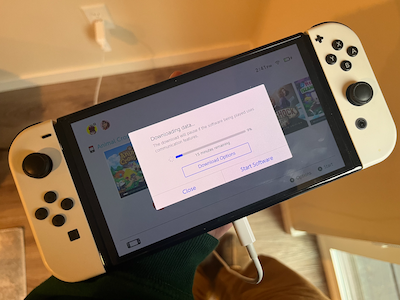
Image: Daphne Kelly
Daphne took her Nintendo Switch and played Animal Crossing online during her testing. She had no problems with freezing, jumping, or lagging, and she downloaded a 10GB game update in just under 10 minutes.
Nora (another one of Zack's daughters) also plays Roblox online and has voice chats with her friends when they play together. She reported that the internet service is usually fine, but there are sometimes periods where the game lags or a call drops. This is a typical experience for people gaming with 5G home internet.
Remember that online gaming is a very internet-intensive activity because it requires high speeds and low latency. As wireless connections, things like 5G home internet and satellite internet have higher latency than wired forms like cable and fiber. Overall, while it can work for low-intensity games like Animal Crossing or Roblox, 5G internet is generally not the best connection for ultra-competitive games like Call of Duty or CS:GO.
Downloading and uploading files
Daphne successfully uploaded an 18-minute video in about three minutes. While it took longer than her home cable connection, 5G internet can still handle the job relatively quickly.
As a video editor, Zack also works with a lot of large files and reported that he usually has no problems with the service.
Streaming
With help from Zack's family, Daphne attempted to slow down their internet system. She tested the system's download speed while streaming hockey on television, letting the kids watch YouTube, and having everyone else use their phones at the same time. Despite multiple people using the service, their T-Mobile 5G Home Internet speed never dropped below 100Mbps.
Zack did note that when he first installed the service, multiple people using the internet at once could cause videos to buffer. However, after he moved the gateway to another location, it largely solved those problems.
T-Mobile 5G Home Internet vs. the competition
T-Mobile 5G Home Internet is not the only 5G internet service. All the major carriers offer them, and some MVNOs (like Mint Mobile's Minternet) are beginning to add them too.
Let's compare the entry 5G internet plans from the Big Three: T-Mobile, Verizon, and AT&T.
T-Mobile 5G Home Internet vs. competitors
| T-Mobile Rely | Verizon 5G Home | AT&T Internet Air | |
|---|---|---|---|
| Data speeds | 87–318Mbps | 50–85Mbps | 75–225Mbps |
| Availability | Widespread | Select cities | Select cities |
| Price | $50/month | $50/month | $60/month |
| Shop plan | Shop plan | Shop plan |
T-Mobile 5G Home Internet vs. Verizon 5G Home
T-Mobile 5G Home Internet is a better value and more accessible than Verizon's plans.
Verizon has the nation's smallest 5G network, and much of it is limited to cities. For that reason, potential customers will generally have an easier time signing up with T-Mobile than Verizon. T-Mobile also offers faster peak speeds at 318Mbps versus Verizon's 85Mbps for the same $50/month price, making T-Mobile the better value overall. Verizon does offer faster speeds for its more expensive plans, but they are still slower than T-Mobile overall.
Truthfully, there's just not much of a contest here, and customers should only consider Verizon 5G internet if they're already a Verizon wireless customer and can bundle for a cheaper price.
Learn more in our in-depth T-Mobile vs. Verizon 5G internet guide.
T-Mobile 5G Home Internet vs. AT&T Internet Air
AT&T Internet Air is a closer competition to T-Mobile 5G Home Internet since both have similar average download speeds. However, T-Mobile 5G Home still has faster peak speeds and lower prices than AT&T Internet Air.
AT&T has the nation's second-largest 5G network, so it can offer service to a lot of cities. However, you may still have trouble signing up. AT&T's biggest internet services are cable and fiber, not 5G home internet. AT&T generally pushes its customers towards a wired plan if available, only allowing select customers to sign up for Internet Air.
T-Mobile 5G Home Internet is still the better option unless you're a current AT&T subscriber. Read more in our T-Mobile vs. AT&T Internet Air guide.
Recap: Do we recommend T-Mobile 5G Home Internet?
We recommend T-Mobile 5G Home Internet for people who have average internet needs who are willing to bundle their service. Our expert who tested the service was so impressed she's considering signing up herself.
With average download speeds around 100Mbps, this internet service is great for things like:
- Streaming movies and TV shows
- Playing video games (non-competitive)
- Scrolling social media and surfing the web
- Remote work
- Virtual learning
The service's pricing is as low as $35/month when bundled with a T-Mobile postpaid voice line. Bundling makes your overall cost for service cheaper and helps combine bills, making the payment process easier.
That said, this internet isn't for everyone. Without a bundle, $50–$70/month is not a great price for 100Mbps download speeds. Additionally, as a wireless service, it's not always the most reliable service, and speeds may spike or drop throughout the day. If you need an internet plan for things like competitive video games, 4K streaming, or a household full of heavy internet users, you may need to look into a cable or fiber plan instead.
Max McCaskill
Sr. Staff Writer

Find a better internet plan
Enter your address to find the best internet providers available in your area.

Related Articles

Related Topics
Internet T-MobilePopular Topics
Internet Spectrum Internet Xfinity Research and Reports AT&T T-Mobile News Verizon App Explainers MINTernetInternet Providers by State
- Internet in Alabama
- Internet in Alaska
- Internet in Arizona
- Internet in Arkansas
- Internet in California
- Internet in Colorado
- Internet in Connecticut
- Internet in Delaware
- Internet in District of Columbia
- Internet in Florida
- Internet in Georgia
- Internet in Hawaii
- Internet in Idaho
- Internet in Illinois
- Internet in Indiana
- Internet in Iowa
- Internet in Kansas
- Internet in Kentucky
- Internet in Louisiana
- Internet in Maine
- Internet in Maryland
- Internet in Massachusetts
- Internet in Michigan
- Internet in Minnesota
- Internet in Mississippi
- Internet in Missouri
- Internet in Montana
- Internet in Nebraska
- Internet in Nevada
- Internet in New Hampshire
- Internet in New Jersey
- Internet in New Mexico
- Internet in New York
- Internet in North Carolina
- Internet in North Dakota
- Internet in Ohio
- Internet in Oklahoma
- Internet in Oregon
- Internet in Pennsylvania
- Internet in Rhode Island
- Internet in South Carolina
- Internet in South Dakota
- Internet in Tennessee
- Internet in Texas
- Internet in Utah
- Internet in Vermont
- Internet in Virginia
- Internet in Washington
- Internet in West Virginia
- Internet in Wisconsin
- Internet in Wyoming