- Slick design, super light
- Great primary camera
- Fantastic performance
- Just okay battery
- Only one rear camera
- Expensive
The iPhone Air is a stunning piece of industrial design that nonetheless leaves me wanting more. The thin-and-light form factor is wonderful to use, but would it have been too much to ask for an extra camera and just a little more battery life? Perhaps I'm being selfish, or asking Apple to defy physics. Maybe both.
There's a lot to love about the iPhone Air, but it's not for everyone. As much as I enjoy having a big screen phone that almost disappears when it's in my pocket, Apple has made compromises to achieve this form factor. And it's not like people were yelling in the streets asking for thinner phones. If anything, the consensus has been it's okay to make phones thicker if that allows for better battery and more cameras.
The iPhone Air is the antithesis to that kind of thinking. A confusing middle child in the 2025 iPhone family. One that is technically outmatched by both its cheaper and more expensive siblings. But neither the iPhone 17 or iPhone 17 Pro can compete with the iPhone Air on style and vibes.
iPhone Air 256GB Plans
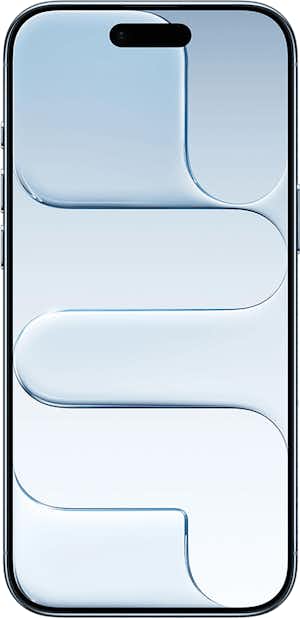
|
XFINITY Mobile

Mobile Select Plan
$0.00/mo
(for the first year of service) <br>Regular rate of $30/mo. thereafter
+ $999.99 Upfront
|
|
Boost Mobile

Unlimited Plan
$10.00/mo
with AutoPay
+ $999.99 Upfront
|
|
Mint Mobile

Unlimited Data Plan
$15.00/mo
Upfront payment required. <br>Intro pricing for new customers only.
+ $999 Upfront
|
Immaculate vibes

Like Samsung's Galaxy S25 Edge, it's much easier to understand the iPhone Air when you see it in person. There's a bit of a wow moment when you pick it up for the first time. Sure, it's thin, at just 5.6mm at its slimmest point, but the iPhone Air's lightweight build is way more important.
The iPhone Air weighs in at 165g, making it 12g lighter than the iPhone 17 or 66g lighter than the iPhone 17 Pro Max. As someone who likes using phones with large displays, the difference is impossible to miss. The iPhone Air makes the iPhone 17 Pro Max feel like a tank.

Weight typically isn't a key consideration when buying a new phone, but it's hard not to be delighted by the balance the iPhone Air strikes. You get a big screen phone that’s easier to use for extended periods of time, and lighter in your pockets. In a way, the iPhone Air reminds me of the iPhone mini with a twist. Instead of a smaller flagship phone, you get a lighter one. A large phone that feels more compact, and there's certainly an appeal to that.
It helps that the iPhone Air is striking as an object. The ultra-thin bezels mean the screen almost blends into the contrasting polished frames, the back glass has a lovely matte feel, and the curvature of the corners is mirrored in the camera bump.
It feels like an affront to put a case on it; it would be defeating the point. While there's always a risk to that, Apple says the iPhone Air is its most durable handset yet. It has Ceramic Shield 2 on the front and back, as well as a titanium frame. I certainly wasn't going to attempt to destroy a phone, but JerryRigEverything has, and Apple's claims seem to check out. It took over 90kg of pressure to make the iPhone Air break.
Aesthetics and build aside, the iPhone Air's 6.5-inch display is a really nice size, a happy medium between the 6.3-inch screen of the standard iPhone 17 and iPhone 17 Pro and the massive 6.9-inch screen on the iPhone 17 Pro Max. The iPhone Air display itself is lovely, featuring a 120Hz refresh rate, an anti-reflective coating, and support for the always-on lock screen first introduced with the iPhone 14 Pro.
The eSIM of it all

One of the iPhone Air's practical changes worth explicitly calling out is the lack of a physical SIM slot. An eSIM is your only option for mobile connectivity.
If you're not familiar with the term, an eSIM is a rewritable SIM card that's built directly into the phone. It never leaves your phone. Instead, you download a "software SIM" from your provider of choice.
eSIM has been available in iPhones since 2018, and the technology is now reasonably widespread across the telco landscape. Major networks like AT&T and Verizon offer SIM plans, as well as MVNOs like Mint Mobile or Visible.
Camera, battery, and performance

The iPhone Air shares its sole 48MP rear-facing camera with the iPhone 17, and look, it's hard to complain with the results on offer. While there's a small step down in low light performance when compared to the iPhone 17 Pro - images have a little more noise and a little less detail - you're still getting one of the very best cameras on the market.
What's more disappointing is the lack of versatility. There's no ultra-wide and no zoom, and three rear-facing cameras is all but standard for this price point. You can technically achieve 2x optical-quality zoom with the primary lens, but that's far less exciting than the versatility offered by the 5x telephoto lenses Apple has equipped its phones with in recent years. While the iPhone Air can still take an okay photo at 4x digital zoom, the results are lacking when compared to the images taken by the 4x images iPhone 17 Pro.
The iPhone Air features Apple's new "Center Stage" selfie camera, which is available across the board in the 2025 devices. The 18MP camera is backed by an unusual square sensor, which allows you to take landscape selfies while holding the phone vertically, and face tracking when making video calls. By and large, the new camera takes great-looking selfies.
iPhone Air camera samples
Check out these camera samples taken on the iPhone Air. Click or tap on any photo to see a larger version.


When it comes to longevity, the iPhone Air's battery is better than expected, but not exactly outstanding. I was typically getting between four and a half and six hours of screen time per charge when testing on 5G. In the worst-case scenario - when screen time was closer to four hours - I was ending my days with less than 10% battery. It was still enough for a full day of moderate usage, but it's not exactly comfortable.
On other testing days, I was getting between five and six hours of screen time, which is a bit more of a useful buffer. While I can't be certain what caused the variance in battery life, I think the number of notifications I received was a contributing factor. On the day I was able to achieve six hours of screen time, I had less than 100 notifications. On my four or so hour days, I had over 200.
For some context, four-and-a-bit hours of screen time is similar to what I saw when testing the standard iPhone 15 Pro. But since then, Apple has improved battery in every single iPhone model to the point where they have a much healthier buffer. I haven't tested the iPhone 17 Pro yet, but last year's iPhone 16 Pro was consistently getting six hours of screen time per charge.

All up, I'd call the iPhone Air's battery just okay. You can live with it, but we've seen battery life improvements across the entire phone industry over the last year or so. Apple is seemingly aware of this, and debuted a new MagSafe Battery Pack specifically for the iPhone Air alongside the device.
While the $159 battery pack itself is reasonably slim, adding it to the iPhone Air kills the thin-and-light vibe. It becomes thicker than most phones, with a combined weight of 290 grams. That's heavier than the iPhone 17 Pro Max. On the plus side, it doesn't feel too clunky when using the iPhone Air with the battery attached, and the magnets are strong enough to keep it from detaching when you put it in your pocket.
I'd still recommend a more traditional battery pack for most. You can get a higher capacity for a cheaper price, even if you don't get MagSafe connectivity.
On the performance front, the iPhone Air is powered by an A19 Pro chipset, similar to this year's Pro models. The difference is one less GPU core, which could result in lower peak performance in very demanding apps, but in most cases, you'd be hard-pressed to tell the difference. Destiny: Rising runs flawlessly on the iPhone Air on "ultra" settings, and barely warms the phone up. All in all, the iPhone Air is a super snappy phone.
Odds and ends

If you haven’t upgraded your iPhone in a while, there are a few other features worth noting on the iPhone Air. They’re not new, but they’ll be new to you.
Dynamic Island: Introduced with the iPhone 14 Pro, the Dynamic Island is a pill-shaped cut-out that houses the selfie camera and tech used for Face ID. On top of this, it acts as a UI element. It expands and contracts to show extra information. If you're listening to music, for example, the Dynamic Island highlights the album art and gives you a little waveform. Long pressing this then gives you access to quick controls, while tapping it takes you back to your music app of choice. It can also highlight other activities like timers or Uber ETAs.
Action Button: Introduced with the iPhone 15 Pro, the Action Button replaces the mute switch. By default, it still works as a mute switch, but it's a lot more flexible. There are out-of-the-box options that let you open the camera, start a voice memo, or turn on the torch, but you can also use it to trigger a Shortcut. If you feel like going down a rabbit hole, Shortcuts on the Action Button allow for deep customization.
USB-C: Apple moved from Lightning to USB-C with the iPhone 15 family. If you've got an iPhone 14 or older, you'll charge with a USB-C cable instead, but there's still one in the box.
Camera Control: Introduced last year on the iPhone 16 family, Camera Control is a new "button" for taking photos. While you can click the Camera Control button, it also acts like a tiny trackpad and allows for features like zooming by scrolling back and forth. I'm personally too entrenched in taking photos the "classic" way, and have mostly only used Camera Control by accident outside of testing, but some may like a more tactile photography option.
Second Generation Photographic Styles: Another feature from last year, Second Generation Photographic Styles are an update to the filter-like adjustments Apple first introduced in the iPhone 13. These let you tweak the "tone", "colour", and in some cases "palette" of an image before you shoot. Colour and palate are fun, but tone is more important. iPhone cameras have historically skewed toward eliminating shadows, which can make some photos look flatter. Adjusting the tone setting lets you bring them back if that’s your thing.
In a similar vein, the iPhone Air makes a few other smaller trade-offs worth calling out.
Just one speaker: The iPhone Air only has a single speaker. It's not bad, but you get a much fuller sound from other recent iPhones.
Slower fast charging: While the iPhone Air supports fast charging, it isn't as fast as the other 2025 models. 30 minutes takes the iPhone Air from flat to 50%, while the rest of the iPhone 17 family can do this in 20 minutes.
USB 2 transfer speeds: The USB-C port on the iPhone Air is pretty slow, limited to 600Mbps. That's the same as the iPhone 17, but the iPhone 17 Pro and iPhone 17 Pro Max USB-C port can operate at speeds of up to 10Gbps. This shouldn't be a problem for most, but it means you don't get features like the option to record video directly to external storage.
The colours aren't as fun as other models: While I appreciate that Apple has ostensibly matched the iPhone Air colours to the current MacBook Air range, the subtler hues make the iPhone Air less fun than other 2025 models. On the iPhone 17 side, you've got options like Lavendar and Sage, and then on the Pros, there's the best iPhone colour in years: Cosmic Orange. By comparison, the barely there Sky Blue doesn't feel that adventurous, even if it is the most interesting iPhone Air colour.
iPhone Air - Final Thoughts

Nine out of ten times, I could comfortably live with the iPhone Air as my daily driver, which is honestly something I'd love to be able to do. But it's the edge cases, the one in ten times issues, that dampen my enthusiasm.
Sure, most of the time I can make it through the day with around four hours of screen time (based on my worst-case scenario day of testing). But at the same time, I've had days at music festivals where even my iPhone 16 Pro Max's battery was taken to the brink and required low power mode to make it through to the end of the day. There's no way the iPhone Air could handle an environment like that.
The iPhone Air battery is workable, but it isn't great if you want to have a bit of a buffer for whatever pops up, even if it's just a day where you don't get home much later than expected, rather than 13 hours at a music festival. Sure, you could keep a battery pack on you, but that's another thing to think about.
In the same vein, I probably take 90% of my photos with the primary lens, no matter what phone I'm using. I mostly only use ultra-wide lenses for macro photos, but I'm a sucker for a long-range zoom lens - especially now that they've gotten fast enough to handle motion.
This is all made more complicated by the $1,799 starting price. The iPhone Air is $400 more expensive than the standard iPhone 17, which is easily the most compelling "entry-level" device Apple has made. There's a larger battery, an extra rear camera, faster charging, and stereo speakers. The iPhone 17 also finally benefits from a 120Hz display, much like the iPhone Air.
If you opt for the iPhone Air, you're spending more money for a less capable device. You're paying a premium for aesthetic and form factor, and perhaps a little taste of the future. For many, the calculus will lead them to decide that the iPhone 17 or the iPhone 17 Pro are simply a better buy for them.
Spending a little more or a little less on one of the iPhone Air's siblings is definitely the pragmatic choice, but there's no denying the iPhone Air is an insanely cool piece of tech. I love the idea of a light, big screen phone, but I just wish it was a little less compromised.
Alex Choros

Find a better phone plan
Thousands of cell phone plans unpacked. All the facts. No surprises.



.png?w=280&h=280&usm=20&usmrad=0.8&fit=crop "Best Cell Phone Deals for July 2026: Get the New iPhone 17 for Free")