
When picking an unlimited data plan, it's important to read the fine print and understand just what data speeds you'll get. There are two things you need to know: how fast your data will be, and whether or not you have a deprioritization threshold (i.e., guaranteed full-speed data).
It's easy to pick an unlimited cell phone plan purely based on monthly cost, however, there is so much fine print that comes with these plans that it may be difficult to really know what you're paying for. Here, we explain exactly what you need to look for when choosing an unlimited data plan, and show you which plans offer the most value.
How fast is your unlimited data?
The first thing you need to understand is data throttling and what it means for your unlimited data plan. Throttling basically means having your data slowed down by the network. This is important to know because some unlimited data plans:
- Only offer throttled data
- Throttle your data when the network is congested
- Throttle your data once you've used up a data cap
Even though your plan is technically "unlimited" it doesn't mean that you're getting unlimited high-speed or 4G LTE data. Which is why it's important to read the fine print.
Take a look at the fine print found on one carrier's site:
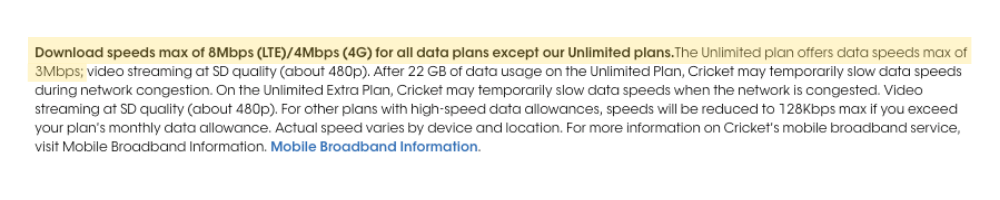
Basically, all of this carrier's plans offer speeds of just 8Mbps, except for one of their unlimited plans which offers speeds of 3Mbps only. For reference, 4G speeds will get you speeds of around 12Mbps. This is a case where a carrier is only offering throttled data on their plans.
When choosing an unlimited data plan, make sure your data is "high-speed" or "premium" 5G or 4G LTE data. Or you'll soon be all too familiar with the video buffering wheel.
Why does data get throttled?
You'll usually experience data throttling if your plan is with an MVNO or smaller carrier. Your data speeds are throttled because of the contract your carrier has with the network it's using (T-Mobile, AT&T, or Verizon). Actual customers of the major networks will get full speed data over MVNO customers. For example, T-Mobile customers will get access to full-speed data first, before Metro by T-Mobile customers.
Deprioritization thresholds (guaranteed high-speed data)
Data deprioritization is a fairly new term for many people, but it's becoming one of the biggest selling points of unlimited plans now. Since basically all plans are unlimited now—with no overage fees—the unique selling point they offer now is how much guaranteed full-speed data you'll be getting.
This is the type of fine print you need to look for:

What you want to look for is how much full-speed data you'll get before you may be subject to deprioritization—in the example above, it's 35GB. In a nutshell, you're guaranteed a full 35GB of full-speed data before your data speeds may be slowed down.
Why is data deprioritized?
Deprioritization happens because the network is busy and can't handle all of the high-speed traffic coming through. So, instead of slowing everyone down, they let a certain number of people get high-speed data while they slow others down. With data deprioritization thresholds, networks are letting those who haven't used much data get the high speeds over those who've used a lot of data.
Language to look out for
What you need to look for in unlimited plans is the exact language that is used when talking about deprioritization and throttled data speeds. You'll usually get one of the two:
- After 30GB of data used, your speeds will be slowed. (Throttling)
- After 30GB of data used, your speeds will be slowed during times of network congestion. (Deprioritization)
- During times of network congestion, your data may be slowed down. (Deprioritization)
Speeds will be slowed (i.e., data cap)
When an unlimited data plan says in the fine print that your data will be slowed down after a certain amount of data use, then it's not really what most of us expect out of an unlimited data plan. It's basically a plan that has a high-speed data cap, but instead of charging you overages, you just get super slow internet speed until next month.
Slowed speeds during network congestion
If your unlimited data plan says your speeds will slow down during times of network congestion, this means you'll still get high-speed data but just not when the network is busy.
There are two different examples here—one with a deprioritization threshold and one without. The plan with a deprioritization threshold is the one you want, for example "After 30GB of data used, your speeds will/may be slowed during times of network congestion."
Your data deprioritization threshold there is 30GB, meaning your data will ONLY be slowed down after you've used 30GB of data and ONLY during times of network congestion. Without this threshold, you data is subject to being slowed down any time the network is congested, even if you've only used 2GB of data that month.
In both cases, however, you'll still be getting full-speed data whenever the network isn't busy, so both are better than having a full-speed data cap.
Unlimited data in a nutshell
That was a lot of information to take in, but it's important information, especially if you're a heavy mobile data user and don't like running out of full-speed data each month. Here's what you really need to know:
A data deprioritization threshold is a good thing. It gives you a guaranteed high-speed data allotment which only is slowed down after you have used that allotment and the network is busy.
Unlimited Plans: Fine Print Explained
| Types of Unlimited Plans | High-Speed Data | When is Data Slowed? |
|---|---|---|
| High-Speed Data Cap e.g., "Your data will be slowed after 30GB of data used." |
Guaranteed amount | Once data cap is reached (until next billing cycle) |
| Deprioritization Threshold e.g., "After 30GB of data used, your data will be slowed during times of network congestion." |
Guaranteed amount | Only after deprioritization threshold is reached and only when network is busy. |
| No Deprioritization Threshold e.g., "During times of network congestion your data may be slowed." |
No guaranteed amount | Anytime the network is busy. |
Plans with the most guaranteed high-speed data
With cell phone carriers no longer charging overage fees for excess data use, one of the ways they try to win your business is by offering more high-speed data with their unlimited plans. Below are some of the plans with the highest deprioritization thresholds, i.e., guaranteed high-speed data.
|
#1
|
Boost Mobile

Unlimited Plan
$10.00/mo
with AutoPay
|
|
#2
|
Metro by T-Mobile (MetroPCS)

Unlimited 6-Month Plan (BYOD)
$20.00/mo
Upfront payment of $120 for 6 months <br>(equivalent to $20/month)<br>Taxes and regulatory fees included.
|
|
#3
|
Metro by T-Mobile (MetroPCS)
$25 Unlimited Plan (BYOD) | Online
$25.00/mo
with AutoPay; $30 for the first month.
|
|
#4
|
Metro by T-Mobile (MetroPCS)
$30 Unlimited Plan (BYOD) | Online
$30.00/mo
|
|
#5
|
Boost Mobile
Global Connection Plan
$40.00/mo
|
|
#6
|
Metro by T-Mobile (MetroPCS)
$40 Period Unlimited Plan
$40.00/mo
Taxes and regulatory fees included.
|
|
#7
|
T-Mobile

Essentials | Eligible First Responders ONLY
$45.00/mo
with Auto-Pay - Taxes & Fees included
|
|
#8
|
Boost Mobile
Unlimited+ Plan
$50.00/mo
with AutoPay
|
|
#9
|
Metro by T-Mobile (MetroPCS)
$50 Unlimited Plan
$50.00/mo
with AutoPay. Taxes and regulatory fees included.
|
|
#10
|
T-Mobile
Essentials Saver
$50.00/mo
with Auto-Pay - Taxes & Fees NOT included
|
Verizon, T-Mobile, and AT&T all offer truly unlimited high-speed premium data that's not subject to deprioritization regardless of how much mobile data you use each month on their top-tier unlimited plans.
|
Verizon

Unlimited Plus
$70.00/mo
+ Taxes & Fees. Price includes AutoPay & Paperless discount.
+ $40 Upfront
|
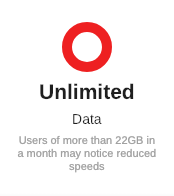
When searching for an unlimited data plan on WhistleOut, we make it easy to see just how much guaranteed high-speed data comes with each plan. Underneath the "Unlimited Data" image, you'll see just how much guaranteed high-speed data you'll get with each individual plan.
If a plan doesn't state the threshold, it generally means that your speeds are subject to being slowed down at any time.
Lauren Hannula
Managing Editor

Find a better phone plan
Thousands of cell phone plans unpacked. All the facts. No surprises.


.png?w=280&h=280&usm=20&usmrad=0.8&fit=crop "Best Cell Phone Deals for July 2026: Get the New iPhone 17 for Free")